
How do Organisms Reproduce (जीव जनन कैसे करते हैं)
Get “How do Organisms Reproduce” chapter’s previous years questions from 2009 to 2020 of JAC board.
Q1. Name such an animal that has external fertilization.
{एक ऐसे जन्तु के नाम लिखिए जिसमें बाह्य निषेचन होता है|}
[su_spoiler title=”Year 2020 of 1 marks” style=”simple” anchor_in_url=”yes”][/su_spoiler]
Ans. Fish, frog
{मछली, मेंढक}
Q2. Through which method is reproduction brought about to the single organism plasmodium?
{एकल जीव प्लाज्मोडियम में जनन किस विधि द्वारा होता है?}
[su_spoiler title=”Year 2018, 2016 of 1 marks” style=”simple” anchor_in_url=”yes”][/su_spoiler]
Ans. Multiple fission
{बहुखंडन}
Q3. Write the name of any one bisexual organism.
{किसी एक उभयलिंगी जंतु का नाम लिखिए|}
[su_spoiler title=”Year 2018 of 1 marks” style=”simple” anchor_in_url=”yes”][/su_spoiler]
Ans. Earthworms
{केंचुआ}
Q4. What type of tropism is the growth of the pollen tube towards the ovule?
{पराग नलिका का बीजाण्ड की ओर वृद्धि करना किस प्रकार का अनुवर्तन है?}
[su_spoiler title=”Year 2016 of 1 marks” style=”simple” anchor_in_url=”yes”][/su_spoiler]
Ans. Chemotropism
{रसायनुवर्तन}
Q5. By which method does asexual reproduction take place in a yeast cell?
{यीस्ट कोशिका में किस विधि द्वारा अलैंगिक जनन होता है?}
[su_spoiler title=”Year 2014 of 1 marks” style=”simple” anchor_in_url=”yes”][/su_spoiler]
Ans. Budding
{मुकुलन}
Q6. Where does fertilization take place in human female?
{मानव मादा में निषेचन कहाँ होता है?}
[su_spoiler title=”Year 2013 of 1 marks” style=”simple” anchor_in_url=”yes”][/su_spoiler]
Ans. Fallopian tube/Oviduct
{फेलोपियन ट्यूब/अंडवाहिका}
Q7. Write the name of one organism each of the following stages
(a) Where binary fission occur.
(b) Where multiple fission occur.
{निम्न अवस्थाओं में प्रत्येक के एक जीव का नाम लिखिए
(a) जहाँ द्विखंडन होता है|
(b) जहाँ बहुखंडन होता है|}
[su_spoiler title=”Year 2012 of 1 marks” style=”simple” anchor_in_url=”yes”][/su_spoiler]
Ans. (i) Amoeba
(ii) Plasmodium
{(i) अमीबा
(ii) प्लैज्मोडियम}
Q8. Name two such organisms which give rise to new organisms by budding.
{ऐसे दो जीवधारिओं के नाम लिखिए जो मुकुलन द्वारा नए जीवधारिओं को उत्पन्न करते हैं|}
[su_spoiler title=”Year 2011 of 1 marks” style=”simple” anchor_in_url=”yes”][/su_spoiler]
Ans. (1) Hydra
(2) Yeast
{(1) हाइड्रा
(2) यीस्ट}
Q9. How does reproduction take place in Spirogyra?
{स्पाइरोगाइरा में प्रजनन किस विधि से होता है?}
[su_spoiler title=”Year 2010 of 1 marks” style=”simple” anchor_in_url=”yes”][/su_spoiler]
Ans. Fragmentation
ie, Spirogyra splits into smaller pieces and these pieces grow into new individuals.
{(a) खंडन
यानी, सपाइरोगाइरा छोटे-छोटे टुकड़ों में बट जाते है और ये टुकड़े वृद्धि कर नए जीव में विकसित हो जाते हैं|}
Q10. By whom does the embryo get nourishment from the mother’s blood?
{किसके द्वारा भ्रूण को माँ के रुधिर से पोषण मिलता है?}
[su_spoiler title=”Year 2009 of 1 marks” style=”simple” anchor_in_url=”yes”][/su_spoiler]
Ans. Placenta
{प्लैसेंटा}
Q11. What are the factors that determine the size of a population?
{कौन से कारक किसी समष्टि के आकार का निर्धारण करते हैं?}
[su_spoiler title=”Year 2020 of 2 marks” style=”simple” anchor_in_url=”yes”][/su_spoiler]
Ans. The factors that determine the size of a population are
(1) Birth rate (The number of babies born every year per 1000 people in a population.)
(2) Death rate (The number of deaths every year per 1000 people in a population.)
{जनसंख्या के आकार को निर्धारित करने वाले कारक हैं
(1) जन्म दर (जनसंख्या में प्रति 1000 लोगों पर प्रति वर्ष जन्म लेने वाले बच्चों की संख्या|)
(2) मृत्यु दर (जनसंख्या में प्रति 1000 लोगों पर हर साल होने वाली मौतों की संख्या|) }
Q12. What are the function of human testes? Write any two functions.
{मानव-वृषण के क्या कार्य हैं? कोई दो कार्य लिखिए|}
[su_spoiler title=”Year 2019 of 2 marks” style=”simple” anchor_in_url=”yes”][/su_spoiler]
Ans. (1) The formation of germ-cells or sperms occurs in the testes.
(2) Testes secret testosterone hormones which brings all changes in boys during puberty.
{(1) नर जनन-कोशिकाओं या शुक्राणु का निर्माण वृषण में होता है|
(2) वृषण टेस्टोस्टेरॉन हार्मोन का उत्पादन करता है जो यौवन के दौरान लड़कों में सभी परिवर्तन लाता है|}
Q13. Why do multicellular organisms need comparatively more complex method for reproduction?
{बहुकोशिकीय जीवों को जनन के लिए अपेक्षाकृत अधिक जटिल विधि की आवश्यकता होती है| क्यों?}
[su_spoiler title=”Year 2017 of 2 marks” style=”simple” anchor_in_url=”yes”][/su_spoiler]
Ans. Many multicellular organisms can not simply reproduce cell by cell division because they are not simply a random collection of cells. Specialised cells are organised as tissues and tissues are organised into organ, which then have to be kept at definite or different positions in the body. That’s why multicellular organisms need comparatively more complex method for reproduction.
{कई बहुकोशिक जीवों में सरल रूप से कोशिका-दर-कोशिका विभाजित नहीं होते क्योंकि वे केवल कोशिकाओं का एक यादृच्छिक समूह नहीं हैं| विशेष कार्य के लिए विशिष्ट कोशिकाएँ संगठित होकर ऊतक का निर्माण करती है और ऊतक संगठित होकर अंग बनाते है, शरीर में इनकी स्थिति भी निश्चित होती है| इसलिए बहुकोशिकीय जीवों को जनन के लिए अपेक्षाकृत अधिक जटिल विधि की आवश्यकता होती है|}
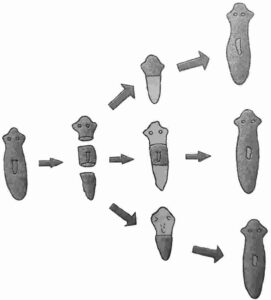
Q14. Observe the figure and answer the questions based on it.
(i) To which animal does this figure belongs?
(ii) Which incident has been determined in this figure.
{आकृति को ध्यान से देखें और उस पर आधारित प्रश्नों के उत्तर दें|
(i) यह चित्र किस जन्तु से सम्बन्धित है?
(ii) चित्र में किस घटना को दर्शाया गया है|}
[su_spoiler title=”Year 2018 of 2 marks” style=”simple” anchor_in_url=”yes”][/su_spoiler]
Ans. (i) Planaria
(ii) The process of regeneration in planaria. Planaria can be broken into a numbers of pieces and each pieces grows into a complete organism.
{(i) प्लेनेरिया
(ii) प्लेनेरिया में पुनरुदभवन (पुनर्जनन) की प्रक्रिया| प्लेनेरिया कई टुकड़ों में टूट जाते है और प्रत्येक टुकड़ा विकसित होकर एक पूर्णजीव का निर्माण कर लेते है|}
Q15. Observe the figure and answer the questions based on it.
(i) In which organism is reproduction demonstrated in the diagram?
(ii) Which method of asexual reproduction is it?
(iii) Describe the method demonstrated by diagram.
{आकृति को ध्यान से देखें और उस पर आधारित प्रश्नों के उत्तर दें|
(i) चित्र में किस जन्तु में प्रजनन दर्शाया गया है?
(ii) यह अलैंगिक जनन की कौन-सी विधि है?
(iii) चित्र द्वारा दर्शायी गई विधि का वर्णन कीजिए|}
[su_spoiler title=”Year 2015 of 2 marks” style=”simple” anchor_in_url=”yes”][/su_spoiler]
Ans. (i) Planaria
(ii) Regeneration
(iii) Planaria can be broken into a numbers of pieces and each pieces grows into a complete organism.
{(i) प्लेनेरिया
(ii) पुनरुदभवन (पुनर्जनन)
(iii) प्लेनेरिया कई टुकड़ों में टूट जाते है और प्रत्येक टुकड़ा विकसित होकर एक पूर्णजीव का निर्माण कर लेते है|}
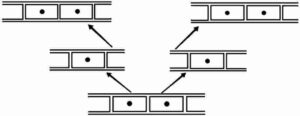
Q16. Observe the diagram and answer the question based on it.
(a) What does the diagram show?
(b) What is the benefit from the process shown in the diagram?
{चित्र का निरीक्षण करें और उस पर आधारित प्रश्न का उत्तर दें|
(a) चित्र क्या दर्शाता है|
(b) चित्र में दर्शाए गए प्रक्रम से क्या लाभ है?}
[su_spoiler title=”Year 2016 of 2 marks” style=”simple” anchor_in_url=”yes”][/su_spoiler]
Ans. (a) Fragmentation in Spirogyra
(b) Spirogyra splits into small pieces and these pieces grow into new individuals.
{(a) सपाइरोगाइरा में खंडन
(b) सपाइरोगाइरा छोटे-छोटे टुकड़ों में बट जाते है और ये टुकड़े वृद्धि कर नए जीव में विकसित हो जाते हैं|}
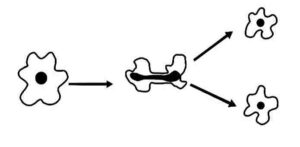
Q17. Observe the figure and answer the questions based on it.
(i) What does the figure represent?
(ii) Introduce the event shown in the figure.
{आकृति को ध्यान से देखें और उस पर आधारित प्रश्नों के उत्तर दें|
(i) चित्र क्या दर्शाती है?
(ii) चित्र में दिखाई गई घटना का परिचय दीजिए|}
[su_spoiler title=”Year 2014 of 2 marks” style=”simple” anchor_in_url=”yes”][/su_spoiler]
Ans. (i) Binary fission in amoeba
(ii) Creation of new individuals in amoeba by splitting into 2 cells. It split into 2 equal halves.
{(i) अमीबा में द्विखंडन
(ii) अमीबा में विखंडन द्वारा नए जीवों की उत्पत्ति होना| यह दो बराबर भागो में विभक्त होता हैं|}
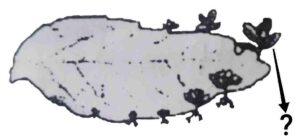
Q18. Observe the figure and answer the questions based on it.
(i) Which process is shown in the figure.
(ii) Name the part in question(?)
{आकृति को ध्यान से देखें और उस पर आधारित प्रश्नों के उत्तर दें|
(i) चित्र में कौन-सी प्रक्रिया दिखाई गई है|
(ii) प्रश्नांकित (?) भाग का नाम बताइए|}
[su_spoiler title=”Year 2013 of 2 marks” style=”simple” anchor_in_url=”yes”][/su_spoiler]
Ans. (i) Vegetative propagation in bryophyllum.
Buds produce in the bryophyllum and rise to new plant.
(ii) Buds
{(i) ब्रायोफिलम में कायिका प्रवर्धन|
ब्रायोफिलम में कलियाँ उत्पन्न होती है और नए पौधे का निर्माण करती है|
(ii) कलियाँ}
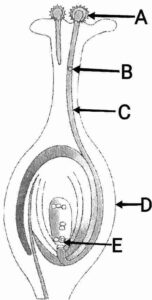
Q19. Write the name of A, B, C and D as directed in the figure.
{चित्र में निर्देशित A, B, C और D के नाम लिखिए|}
[su_spoiler title=”Year 2011 of 2 marks” style=”simple” anchor_in_url=”yes”][/su_spoiler]
Ans. (A) Pollen grain
(B) Male germ cell
(C) Pollen tube
(D) Ovary
(E) Female germ cell
{(A) पराग कण
(B) नर युग्मक
(C) पराग नली
(D) अंडाशय
(E) मादा युग्मक}
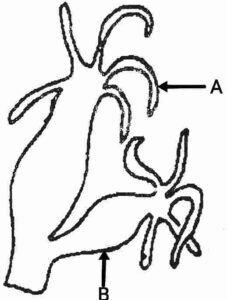
Q20. Name the questioned parts of the following figure and state which method of reproduction it represents.
{निम्नांकित चित्र के प्रश्नांकित भागों के नाम लिखिए और बताइए कि यह प्रजनन की किस विधि को दर्शाता है|}
[su_spoiler title=”Year 2010 of 2 marks” style=”simple” anchor_in_url=”yes”][/su_spoiler]
Ans. A- Tentacles
B- Bud
Method of reproduction- Budding
{A- स्पर्शक
B- मुकुल
प्रजनन की विधि- मुकुलन}
Q21. How is binary fission different from multiple fission? Write any two differences.
{द्विखंडन बहुखंडन से किस प्रकार भिन्न होता है? कोई दो अंतर लिखिए|}
[su_spoiler title=”Year 2009 of 2 marks” style=”simple” anchor_in_url=”yes”][/su_spoiler]
Ans.
| Binary fission | Multiple fission |
| (1) In this method, unicellular organisms is divided into two parts and each part develops into a new organisms. | (1) In this method, unicellular organisms is divided into many parts and each part develops into a new organisms. |
| (2) Nucleus divides into two parts. | (2) Nucleus divides into many parts. |
| (3) Ex:- Amoeba | (3) Ex:- Plasmodium |
{
| द्विखंडन | बहुखंडन |
| (1) इस विधि में एककोशिकीय जीव दो भागों में विभाजित हो जाता है और प्रत्येक भाग एक नए जीव के रूप में विकसित हो जाता है| | (1) इस विधि में एककोशिकीय जीव कई भागों में विभाजित हो जाता है और प्रत्येक भाग एक नए जीव के रूप में विकसित हो जाता है। |
| (2) केंद्रक दो भागों में विभाजित होता है| | (2) केंद्रक कई भागों में विभाजित होता है| |
| (3) Ex:- अमीबा | (ii) Ex:- प्लैज्मोडियम |
}
9113323460

I hope you like it. If you like then please share it and you can also Donate to our website by my number and QR code which is given above.
Thanks.
Next Chapter Heredity and Evolution (आनुवांशिकता एवं जैव विकास)