
Chemical Reactions and Equations (रासायनिक अभिक्रियाएँ एवं समीकरण)
Get “Chemical Reactions and Equations” chapter’s previous years questions from 2009 to 2020 of JAC board.
Q1. Chemical reaction is which type of reaction?
{रासायनिक अभिक्रिया किस प्रकार की अभिक्रिया है?}
[su_spoiler title=”Year 2020 of 1 marks” style=”simple” anchor_in_url=”yes”][/su_spoiler]
Ans. Displacement reaction
{विस्थापन अभिक्रिया}
Q2. What type of chemical reaction is respiration?
{श्वसन कैसी रासायनिक अभिक्रिया है?}
[su_spoiler title=”Year 2019 of 1 marks” style=”simple” anchor_in_url=”yes”][/su_spoiler]
Ans. Exothermic reaction
{उष्माक्षेपी अभिक्रिया}
Q3. Identify the type of reaction in
{ में अभिक्रिया के प्रकार की पहचान कीजिए|}
[su_spoiler title=”Year 2018 of 1 marks” style=”simple” anchor_in_url=”yes”][/su_spoiler]
Ans. Combination reaction
{संयोजन अभिक्रिया}
Q4. Name the following reaction
{निम्नलिखित अभिक्रिया का नाम लिखिए|}
[su_spoiler title=”Year 2017 of 1 marks” style=”simple” anchor_in_url=”yes”][/su_spoiler]
Ans. Double displacement reaction
{द्विविस्थापन अभिक्रिया}
Q5. What happens when dilute hydrochloric acid is added to iron fillings?
{लौह-चूर्ण पर तनु हाइड्रोक्लोरिक अम्ल डालने से क्या होता है?}
[su_spoiler title=”Year 2012 of 1 marks” style=”simple” anchor_in_url=”yes”][/su_spoiler]
Ans. When dilute hydrochloric acid is added to iron fillings then Iron chloride and hydrogen gas are produced.
{लौह-चूर्ण पर तनु हाइड्रोक्लोरिक अम्ल डालने से आयरन क्लोराइड और हाइड्रोजन गैस का उत्पादन होता है|
अर्थात् }
Q6. Hydrogen sulphide gas burns in air to give water and sulphur dioxide. Give balanced chemical equation.
{हाइड्रोजन सल्फाइड गैस का वायु में दहन होने से जल एवं सल्फर डाइऑक्साइड बनता है| संतुलित रासायनिक समीकरण दीजिए|}
[su_spoiler title=”Year 2012 of 1 marks” style=”simple” anchor_in_url=”yes”][/su_spoiler]
Ans.
Q7. Why should a magnesium ribbon be cleaned before burning in air?
{धातु में जलाने से पहले मैग्नीशियम रिबन को साफ क्यों किया जाता है?}
[su_spoiler title=”Year 2018 of 2 marks” style=”simple” anchor_in_url=”yes”][/su_spoiler]
Ans. Magnesium ribbon be cleaned before burning in air because it is a very reactive element, which rapid react with oxygen in the air and form a layer of magnesium oxide. This layer prevent or slow down the burning of magnesium ribbon.
{मैग्नीशियम रिबन को हवा में जलाने से पहले साफ कर लेना चाहिए क्योंकि यह एक बहुत ही प्रतिक्रियाशील तत्व है, जो हवा में ऑक्सीजन के साथ तेजी से प्रतिक्रिया कर लेती है और मैग्नीशियम ऑक्साइड की एक परत बना लेती है| यह परत मैग्नीशियम रिबन को जलने से रोकती या धीमा करती है|}
Q8. What is meant by exothermic and endothermic reaction? Give example.
{ऊष्माक्षेपी तथा ऊष्माशोषी अभिक्रियाओं के क्या अर्थ है? उदाहरण दीजिए|}
[su_spoiler title=”Year 2010 of 2 marks” style=”simple” anchor_in_url=”yes”][/su_spoiler]
Ans. Exothermic reactions:- Those reactions in which heat is evolved is called exothermic reactions.
Ex:- Respiration
Endothermic reactions:- Those reactions in which energy is absorbed either in the form of heat, electricity or light is called endothermic reaction.
Ex:- Decomposition reaction
{ऊष्माक्षेपी अभिक्रियाएँ:- वे अभिक्रियाएँ जिनमें ऊष्मा उत्पन्न होती है ऊष्माक्षेपी अभिक्रियाएँ कहलाती हैं|
उदाहरण:- श्वसन
ऊष्माशोषी अभिक्रियाएँ:- वे अभिक्रियाएँ जिनमें ऊर्जा या तो ताप, विद्युत या प्रकाश के रूप में अवशोषित होती है, ऊष्माशोषी अभिक्रियाएँ कहलाती है|
उदाहरण:- अपघटन या वियोजन अभिक्रिया}
Q9. Observe the given figure and answer the following questions.
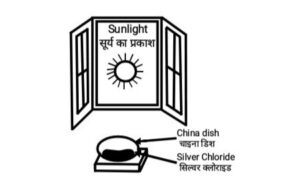
(i) Write the change of colour that takes place in this reaction.
(ii) Write the balanced chemical equation of this reaction.
{दी गई आकृति का अवलोकन कीजिए और निम्नलिखित प्रश्नों के उत्तर दें|
(i) इस अभिक्रिया में होने वाले रंग परिवर्तन को लिखिए|
(ii) इस अभिक्रिया का संतुलित समीकरण लिखिए|
[su_spoiler title=”Year 2016 of 2 marks” style=”simple” anchor_in_url=”yes”][/su_spoiler]
Ans. (a) Silver chloride turns grey colour.
(b)
{(a) सिल्वर क्लोराइड धूसर रंग में बदल जायेगा|
(b) }
Q10. Observe the given diagram and answer the following questions.
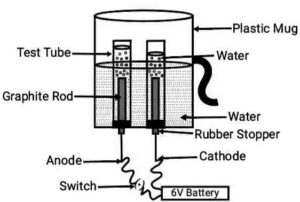
(i) Write the type of reaction being shown in the diagram?
(ii) Write either the name or symbol of the products obtained at anode and cathode.
{दिए गए चित्र को ध्यान से देखिए और निम्नलिखित प्रश्नों के उत्तर दीजिए|
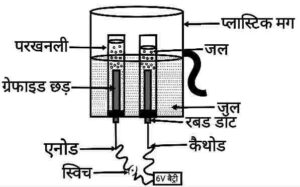
(i) चित्र में किस प्रकार की अभिक्रिया दर्शाई गई है?
(ii) एनोड और कैथोड पर प्राप्त होने वाले उत्पादों के नाम अथवा संकेत लिखें|
[su_spoiler title=”Year 2015 of 2 marks” style=”simple” anchor_in_url=”yes”][/su_spoiler]
Ans. (i) Decomposition reaction
(ii) Anode – Oxygen
Cathode – Hydrogen
{(i) अपघटन अभिक्रिया
(ii) एनोड – ऑक्सीजन
कैथोड – हाइड्रोजन }
Q11. The reaction of water with CaO has been shown in the given diagram.
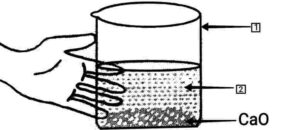
(a) Write the name of (1) and (2)
(b) Write the name of reaction taking place.
(c) Write the balanced equation for the reaction taking place.
{दिए गए चित्र में जल के साथ CaO की अभिक्रिया को दर्शाया गया है|
(a) (1) और (2) के नाम लिखिए|
(b) इनमें होने वाली अभिक्रिया का नाम लिखिए|
(c) अभिक्रिया के लिए संतुलित समीकरण लिखिए|}
[su_spoiler title=”Year 2020 of 3 marks” style=”simple” anchor_in_url=”yes”][/su_spoiler]
Ans. (a) (1) Beaker (2) Water
(b) Combination reaction
{(a) (1) बीकर (2) जल
(b) संयोजन अभिक्रिया
}
Q12. Look at the given figure and answer the following questions.
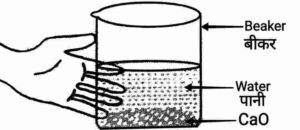
(i) Which compound will be formed by this experiment? Write the chemical equation of this reaction.
(ii) Is this reaction exothermic or endothermic?
{दी गई आकृति को देखें और निम्नलिखित प्रश्नों के उत्तर दें|
(i) इस प्रयोग से किस यौगिक का निर्माण होगा? अभिक्रिया का रासायनिक समीकरण लिखिए|
(ii) यह अभिक्रिया ऊष्माक्षेपी है या ऊष्माशोषी?}
[su_spoiler title=”Year 2014 of 2 marks” style=”simple” anchor_in_url=”yes”][/su_spoiler]
Ans. (i) Slaked lime
{(i) बुझा हुआ चुना
}
Q13. Look at the given figure and answer the following questions.
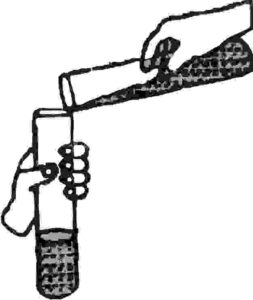
(a) Write the name of the reaction taking place in it.
(b) Is there any precipitate formed in such a reaction? If yes, write its chemical formula and colour.
{दी गई आकृति को देखें और निम्नलिखित प्रश्नों के उत्तर दें|
(a) इसमें होने वाली अभिक्रिया का नाम लिखें|
(b) क्या इस अभिक्रिया में कोई अवक्षेप भी बनता है? यदि हाँ, तो इसका रासायनिक सूत्र और रंग लिखिए|
[su_spoiler title=”Year 2013 of 2 marks” style=”simple” anchor_in_url=”yes”][/su_spoiler]
Ans. (a) Double displacement reaction
(b) Yes
Chemical formula –
Colour – White
{(a) द्विविस्थापन अभिक्रिया
(b) हाँ
रासायनिक सूत्र –
रंग – सफेद}
Q14. Explain oxidation and reduction in terms of gain or loss of oxygen. Mention one example for each other.
{ऑक्सीजन के योग या ह्रास के आधार पर उपचयन एवं अपचयन की व्याख्या कीजिए| प्रत्येक के लिए एक उदाहरण दीजिए|}
[su_spoiler title=”Year 2019 of 3 marks, 2012 of 2 marks” style=”simple” anchor_in_url=”yes”][/su_spoiler]
Ans. Oxidation:- The reaction in which substance gain oxygen or loss hydrogen is called oxidation reactions.
Ex:-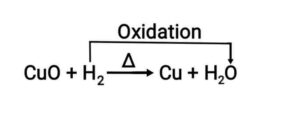
Reduction:- The reaction in which substance loss oxygen or gain hydrogen is called reduction reactions.
Ex:- 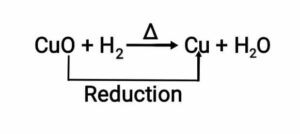
{उपचयन:- वह अभिक्रिया जिसमें पदार्थ ऑक्सीजन का योग करता है या हाइड्रोजन को ह्रास करता है उसे उपचयन अभिक्रिया कहते हैं|
उदहारण:-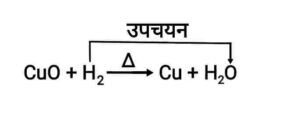
अपचयन:- वह अभिक्रिया जिसमें पदार्थ ऑक्सीजन को ह्रास करता है या हाइड्रोजन को योग करता है उसे अपचयन अभिक्रिया कहते हैं|
उदहारण:-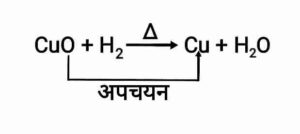 }
}
Q15. Write balanced chemical equation for each type of reaction given below:
(a) Redox reaction
(b) Decomposition reaction
(c) Double displacement reaction
{नीचे दी गई प्रत्येक प्रकार की अभिक्रिया के लिए एक संतुलित रासायनिक समीकरण लिखें:
(a) रेडॉक्स अभिक्रिया
(b) अपघटन या वियोजन अभिक्रिया
(c) द्विविस्थापन अभिक्रिया}
[su_spoiler title=”Year 2015 of 3 marks” style=”simple” anchor_in_url=”yes”][/su_spoiler]
Ans.
Q16. Write one equations each for decomposition reactions where energy is supplied in the form of heat, light or electricity?
{उन वियोजन (अपघटन) अभिक्रियाओं के एक-एक समीकरण लिखिए जिनमें ऊष्मा, प्रकाश या विघुत के रूप में ऊर्जा प्रदान की जाती है?}
[su_spoiler title=”Year 2010 of 3 marks” style=”simple” anchor_in_url=”yes”][/su_spoiler]
Ans. (a) Decomposition by heat
(b) Decomposition by light
(c) Decomposition by electricity
{(a) ऊष्मा से वियोजन
(b) प्रकाश से वियोजन
(c) विघुत से वियोजन
}
Q17. Balance the following chemical equations:
{निम्नलिखित रासायनिक समीकरणों को संतुलित कीजिए:}
[su_spoiler title=”Year 2020 of 2 marks” style=”simple” anchor_in_url=”yes”][/su_spoiler]
Ans.
Q18. Balance the following chemical equations:
{निम्नलिखित रासायनिक समीकरणों को संतुलित कीजिए:}
[su_spoiler title=”Year 2019 of 2 marks” style=”simple” anchor_in_url=”yes”][/su_spoiler]
Ans.
Q19. Write the balanced equation for the following chemical reactions
(a) Hydrogen Nitrogen
Ammonia
(b) Sodium Water
Sodium Hydroxide
Hydrogen
(c) Methane Oxygen
Carbon dioxide
Water
{निम्नलिखित रासायनिक अभिक्रियाओं के लिए संतुलित समीकरण लिखिए|
(a) हाइड्रोजन नाइट्रोजन
अमोनिया
(b) सोडियम जल
सोडियम हाइड्रॉक्साइड
हाइड्रोजन
(c) मिथेन ऑक्सीजन
कार्बन डाइऑक्साइड
जल}
[su_spoiler title=”Year 2018 of 3 marks” style=”simple” anchor_in_url=”yes”][/su_spoiler]
Ans.
Q20. Balance the following chemical equations:
{निम्नलिखित रासायनिक समीकरणों को संतुलित कीजिए:}
[su_spoiler title=”Year 2017 of 3 marks” style=”simple” anchor_in_url=”yes”][/su_spoiler]
Ans.
Q21. Balance the following chemical equations:
{निम्नलिखित रासायनिक समीकरणों को संतुलित कीजिए:}
[su_spoiler title=”Year 2016 of 3 marks” style=”simple” anchor_in_url=”yes”][/su_spoiler]
Ans.
Q22. Write balanced chemical equation for the following reaction:
(i) Sodium Water
Sodium hydroxide
Hydrogen
(ii) Calcium carbonate Calcium oxide
Carbon dioxide
(iii) Nitrogen Hydrogen
Ammonia
{निम्नलिखित अभिक्रिया के लिए संतुलित रासायनिक समीकरण लिखिए:
(i) सोडियम जल
सोडियम हाइड्रॉक्साइड
हाइड्रोजन
(ii) कैल्शियम कार्बोनेट कैल्शियम ऑक्साइड
कार्बन डाइऑक्साइड
(iii) नाइट्रोजन हाइड्रोजन
अमोनिया }
[su_spoiler title=”Year 2014 of 3 marks” style=”simple” anchor_in_url=”yes”][/su_spoiler]
Ans.
Q23. Balance the following chemical equations:
{निम्नलिखित रासायनिक समीकरणों को संतुलित कीजिए:}
[su_spoiler title=”Year 2013 of 3 marks” style=”simple” anchor_in_url=”yes”][/su_spoiler]
Ans.
Q24. Balance the following chemical equations:
{निम्नलिखित रासायनिक समीकरणों को संतुलित कीजिए:}
[su_spoiler title=”Year 2012 of 3 marks” style=”simple” anchor_in_url=”yes”][/su_spoiler]
Ans.
Q25. Balance the following chemical equations:
{निम्नलिखित रासायनिक समीकरणों को संतुलित कीजिए:}
[su_spoiler title=”Year 2011 of 3 marks” style=”simple” anchor_in_url=”yes”][/su_spoiler]
Ans.
Q26. Balance the following chemical equations:
{निम्नलिखित रासायनिक समीकरणों को संतुलित कीजिए:}
[su_spoiler title=”Year 2009 of 3 marks” style=”simple” anchor_in_url=”yes”][/su_spoiler]
Ans.
9113323460

I hope you like it. If you like then please share it and you can also Donate to our website by my number and QR code which is given above.
Thanks.